
The incredible power of perspective
Updated: Apr 19

Perhaps we are not separate at all from each other, the planet, the universe or the cosmos.
Without apology my life arrived at a point where it demanded a giant step back to breathe, relax and fully engage with my own souls authentic truth of love, life, family, work, and how to experience the experiences of all things fully with a very different perspective.

As far back as memory currently reaches, my curiosity about life and everything it involves has been active to say the least. Unfortunately this makes being in the world a very different experience and the older I get the more different it feels. Not good or bad, simply different.
When I think back School was the start. Like much as the things I see today wrapped up in the same dreary old bundle of the day to day routine, I found school dull, uninspiring, and frankly easy to the point of boredom. Even at 12 years old it felt like an outdated institution struggling to keep up with the questions that actually fascinated me, the kinds of questions that, if better understood, could have a profound impact on our lives and wellbeing.

So what happens when you are neuro-spicy, have an insatiable appetite for knowledge, and develop a persistent urge to understand how the universe actually works?
Other than potentially not getting invited to watch the football down the Lion or asked to join "the lads" down the local, you spend a lifetime asking questions. Lots of questions.
Questions like this… What if we are not separate individuals at all, but different perspectives through which one interconnected universe experiences itself?
What I love is that there is a far richer deeper way to experience the experience of life. If we look from a different perspective, the microscopic cells of our body to the largest structures in the cosmos, we can see that the same kinds of patterns appear again and again, and that could have a profound impact on how we experience each other and life itself.
Science has a name for this. Emergence.
The pattern across scale.
Recently I spent time comparing very different sets of images. Some came from satellite telescopes capturing the universe at its largest visible scale. The others came from microscopes examining the human body at its most microscopic levels. What struck me almost immediately was how similar they looked. The vast filaments linking galaxies across the cosmic web resembled neural networks in the brain. Cellular structures echoed patterns seen in deep space, and the further I zoomed out into the universe, then back toward the molecular structures of life, the more the same kinds of patterns seemed to appear.

(Human brain imaging)
What surprised me even more was that the similarities were not limited to the images. The patterns of behaviour we see in human life connection, cooperation, conflict, growth, collapse, birth, death, adaptation all begin to resemble the same dynamics that operate inside us at microscopic levels and across the universe at its largest scales. Blood cells move through networks not unlike cities and supply chains. Immune systems respond to threats much like societies do. Ecosystems organise themselves through cooperation and competition. Even galaxies cluster, collide, and reorganise within vast gravitational networks.
At first this might sound philosophical, but there is actually a well-established scientific concept that helps explain why this might happen: emergence.
Emergence describes how complex systems produce properties that do not exist in the individual parts themselves. Consciousness emerges from billions of interacting neurons. Life emerges from chemistry. Ecosystems emerge from the relationships between organisms. When enough elements interact in structured ways, entirely new levels of behaviour appear.

(Mouse brain imaging)
The unanswered question.
This for me raises a fascinating possibility. If consciousness can emerge from the complexity of the brain, could something else emerge from the vast complexity of the universe itself?
We simply can't yet definitively answer yes or no, although it does raise fascinating questions and incredible possibilities that would change our perspective of the human experience and how we live as patterns of energy as life unfolds.

(Model of the observable universe at 96billion light years across zoomed out)
The deeper we look from neurons to ecosystems and out across galaxies the more reality begins to resemble repeating patterns across scale which ultimately leads to the question explored in this article:
Are we separate individuals living in a universe or simply different perspectives through which one interconnected system experiences itself?
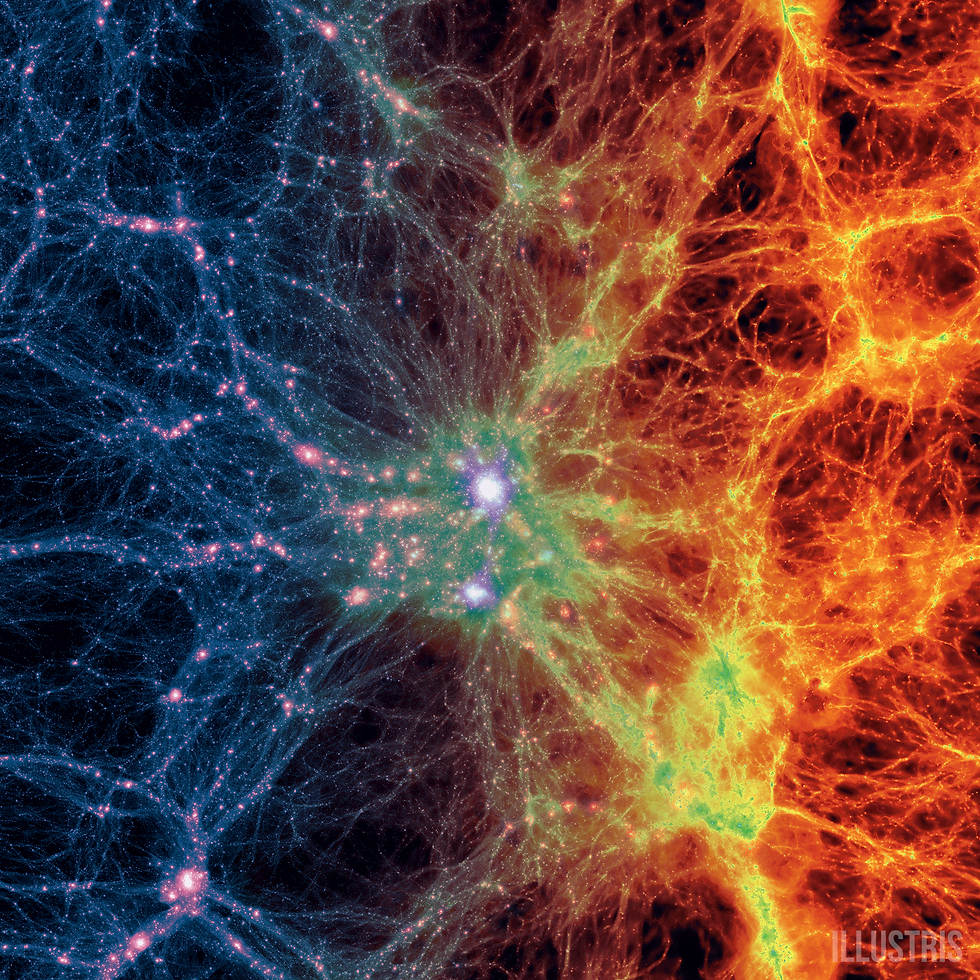
Consciousness might not belong to humans. Humans might belong to consciousness.
For centuries we have assumed the same basic story.
The universe produced matter. Matter produced life. Life produced brains. And somewhere inside those brains, consciousness appeared.
What if that story is incomplete?
What if consciousness is not something we possess, but something we participate in?
The quiet scientific clue: emergence
The closest scientific idea to this possibility is the concept of emergence which is a principle seen everywhere in nature.
Emergence describes how complex systems produce properties that don’t exist in their individual parts.

Consider a few examples.
Consciousness emerges from neurons. A single neuron is not aware. Yet billions interacting produce awareness.
Life emerges from chemistry. Individual molecules are not alive. Yet organised together they create living systems.
Ecosystems emerge from organisms. No single organism creates an ecosystem. Yet together they generate a living network.
In each case something new appears that cannot be explained by the pieces alone.
A new level of reality emerges that is both fascinating and mind blowing.
The cosmic parallel
This raises a deeper possibility scientists quietly debate.
If consciousness can emerge from the complexity of the brain, could something else emerge from the complexity of the universe itself?

After all:
The brain contains roughly 86 billion neurons.
The observable universe contains roughly two trillion galaxies, each holding billions of stars.
At vast scales the universe also forms networks of galaxies linked in filaments known as the cosmic web.
Different physics. Different scales.
Yet strikingly similar patterns of connection and structure appear.
Which raises an uncomfortable and fascinating possibility:
Could cosmic-scale complexity produce some form of higher-level emergence?
Science does not currently have an answer.
And honesty requires saying something simple:
We simply don’t know yet.
The perspective shift
Perhaps then the question itself might be framed incorrectly.
We all grow up asking different questions, one of mine has always been.
Are we separate individuals living inside a universe?
On reflection this could easily be framed another way and may be just as valid:
Are individuals simply the universe observing itself from different locations?

This idea appears in different forms across philosophy, physics, and contemplative traditions.
Importantly, it doesn’t suggest that human beings are the centre of existence. Quite the opposite. If anything, it challenges the assumption that we occupy any privileged position in the universe at all.
It suggests that what we call a “self” might simply be a temporary viewpoint within a much larger process. A local expression of something vastly more interconnected.
There is, however, an interesting side note I quite like.
While humans may not be the centre of existence, every individual is, in a very real sense, the centre of their observable universe.
How?
Without disappearing too far down a physics rabbit hole, it comes down to the nature of light and observation. Everything we see in the universe reaches us as light that has travelled across space for years, centuries, or even billions of years before arriving at our eyes or our telescopes. From the perspective of any observer, the observable universe appears as a sphere expanding outward from the point where that observer happens to be.

In other words, wherever you are standing, the universe you can observe unfolds around you.
Every observer experiences the universe as if they are at its centre.
Not because they are the centre of existence but because perspective itself always begins from a single point of observation.
What science actually says
Science cannot currently prove that the universe is a single conscious system, neither can it completely rule out the possibility that consciousness is more fundamental than we once believed.
What science does increasingly reveal is that reality is deeply relational. Atoms form molecules. Molecules form cells. Cells form organisms. Organisms form ecosystems. Stars form galaxies. Galaxies form cosmic networks.
Every level of reality emerges from relationships between the level beneath it.
Which leads to one final, unsettling possibility.
Perhaps consciousness is not the top of that ladder.
Perhaps it is simply another level emerging within it.

A different way to see ourselves
If that is even partially true, then the most profound shift is not scientific but existential.
We are not isolated observers looking out at a cold universe.
We are participants inside a vast unfolding system fundamentally the same energy unfolding as everything else in the universe. The atoms in our bodies were forged in ancient stars. The oxygen we breathe was made in stellar explosions. The neural activity generating this thought is powered by sunlight stored in plants.
From that perspective the boundary between “self” and “cosmos” becomes less clear.
Not mystical. Just factual.
The universe is not something we stand apart from.
It is something we are made of.
Perhaps the most honest conclusion, for now, is simply this:
We may not yet understand consciousness but the deeper we look from neurons to galaxies, the more reality begins to resemble a network of relationships unfolding across scale. And within that network, each of us is a brief but remarkable vantage point. A place where the universe becomes aware of itself, if only for a moment.
Ultimately therefore our own perspective may be far more powerful than we realise.
And should it all be proven to be true?
If ideas like this were ever proven to be true and if it turned out that consciousness does not belong to us individually, but that we are expressions of a much larger interconnected system, the implications for the human experience would be profound.
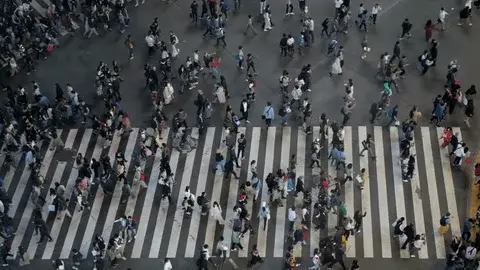
First, it would quietly dissolve one of the deepest illusions we carry: the idea that we are separate from everything else. The boundaries we defend so fiercely between individuals, nations, ideologies, even species would begin to look less like absolute divisions and more like temporary viewpoints within a single unfolding process.
From that perspective, much of what drives human drama would start to lose its grip. Ego thrives on separation. It depends on the belief that “I” must win, dominate, protect, accumulate, and defend against “others.”

However, if we are all expressions of the same interconnected system, the logic of constant conflict becomes strangely irrational. Harming others would increasingly resemble harming another part of the same body.
That does not mean difference disappears. Diversity would still exist just as different cells in the body perform different functions, or different ecosystems play different roles within the biosphere yet cooperation would begin to feel more natural than domination, and stewardship more sensible than extraction.

Our relationship with the planet might also change. If we understood ourselves not as owners of Earth but as participants within a larger living system, the idea of destroying ecosystems for short-term gain would start to feel as absurd as intentionally damaging our own organs. Care would not arise from moral obligation alone, but from simple recognition.
Even our personal lives might feel different. Much of the anxiety that drives modern life comes from the pressure to defend and construct a permanent identity, to prove who we are, to win comparisons, to control outcomes. Yet if we are simply temporary vantage points within a larger process, the need to constantly reinforce the self begins to soften. Life becomes less about proving and more about participating.
In that sense, the discovery would not diminish humanity. It would place us in a far richer context.
We would still love, create, struggle, build, and explore although the drama of ego, the endless attempt to fix, control, dominate, or destroy everything around us might slowly give way to something quieter and more intelligent: awareness of the system we are part of and responsibility for how we move within it.

Seen this way, the human experience becomes something extraordinary.
Not a species fighting for position in a meaningless universe.
It would be as it already is, a series of magical moments in which the universe becomes aware of itself through billions of different perspectives, each briefly alive, each connected to everything else.
And perhaps that realisation alone would be enough to change how we choose to live together.
So maybe seeing is not believing after all, our basic constructed reality is not set in stone and ultimately we are the interconnected multiverse. Perhaps we are not separate from the universe at all and we are simply the place where it becomes aware of itself.
Maybe it is time we saw things differently. Not better or worse, just different.


